The Intentional Blue Zone: Designing the Environment Your Future Self Requires
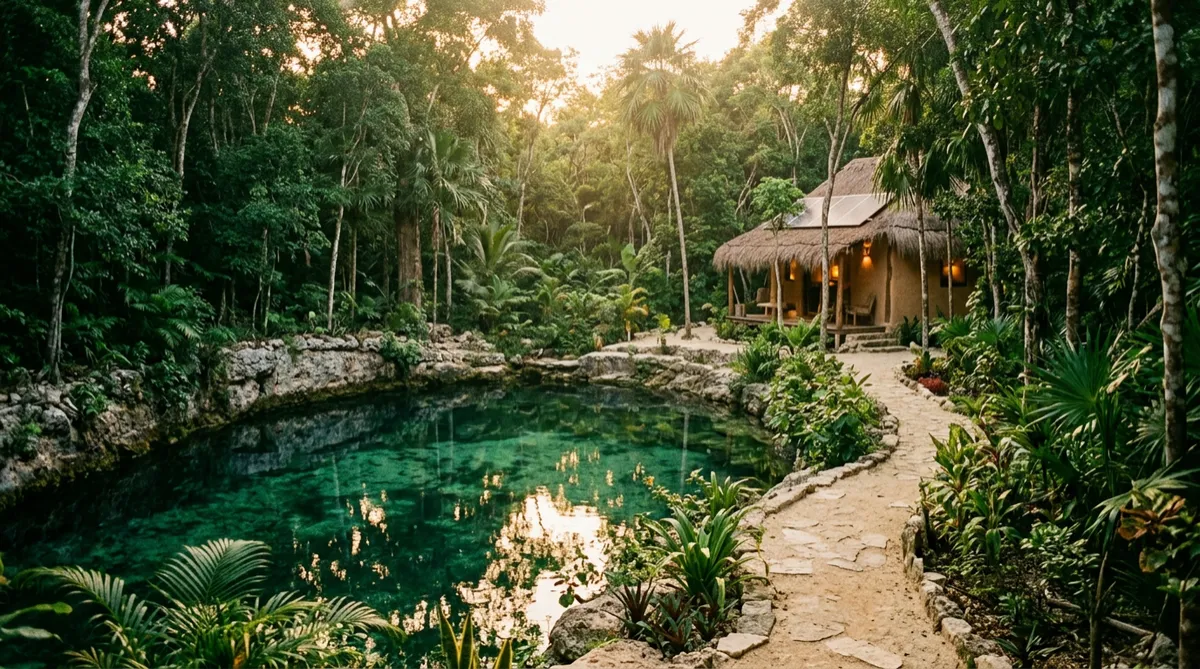
Imagine the hour before the heat arrives. Mist lifts off a cenote lake the colour of old glass. Beyond the corn rows, a neighbour is already laughing. Your feet know the path to the farm because they have walked it every morning — not because a device asked them to. Nobody here is “doing” longevity. They are simply living inside it.
This is the quiet premise of the intentional Blue Zone: that a long, vital life is less a discipline than a landscape. The world’s celebrated longevity villages were never designed. They were inherited, slowly, from centuries of walking, growing, sharing and belonging. But what if a place could be composed with that same intelligence, on purpose, from the first stone? What if the environment did the quiet work, and willpower could finally rest?
The timing is not accidental. In January 2026, a Weizmann Institute team reported in Science that genes may account for roughly half of the variation in human lifespan — at least double the older 20–25% estimates — after modelling out deaths from accidents and infection. Specialists were quick to add nuance: the older and newer figures, one Danish epidemiologist noted, measure different things. The Blue Zones themselves are under scrutiny too. Harvard Health quotes Dr. Willett saying the theory alone is “not regarded as strong science,” even as the habits it describes remain consistent with what we know about diet, movement and connection. Honest science does not dissolve the idea of a longevity village. It sharpens it. If roughly half of our span is inherited, the other half is shaped by the place we wake up in — and almost no one chooses that place on purpose.
Why an Intentional Blue Zone Begins With Environment, Not Willpower
A published review of the Blue Zones Project notes that people spend about 90% of their lives within five miles of home — their “Life Radius” — and concludes that making the individual solely responsible for a healthy environment does not work. Change has to be built into the surroundings, so the healthy choice becomes the easy one. The longest-lived people, the Blue Zones Project observes, do not pump iron or join gyms; they live in surroundings that nudge them into moving without thinking. They walk everywhere. They grow gardens. They stay active all day.
The same review reports a 3.2-year rise in life expectancy in Albert Lea after roughly eighteen months of environmental redesign. That is a programme-reported figure, not an independently verified one, and we hold it lightly. The direction is the point: place precedes habit. Design the path, the table, the pantry and the light, and behaviour follows with far less negotiation.
Belonging as Longevity Medicine: The Social Side of an Intentional Blue Zone
The strongest signal in the literature may not be on any plate. A meta-analysis of 148 studies and 308,849 participants by Julianne Holt-Lunstad and colleagues found that people with strong social ties had roughly a 50% greater likelihood of survival than those with weak ones — an effect often compared with that of quitting smoking. These are observational findings: they show association, not proof of causation. Still, the pattern recurs.
In Okinawa, children are placed in a moai, a circle of friends who commit to one another for life. One moai documented by the Blue Zones team had been together for 97 years, its members averaging 102. If one failed to appear, the other four walked across the village to check on them. The Framingham studies, meanwhile, suggest that happiness — and loneliness — are contagious. Belonging is not a garnish on longevity. It is infrastructure.
Genes, Luck and the Half You Can Design
None of this makes biology irrelevant. The Weizmann work draws on Swedish and Danish twin cohorts, including twins raised apart, and its authors stress that heritability is always environment-specific and population dependent. Critics add that removing external causes of death means measuring “lifespan under a specific set of conditions”, and that the study populations were largely white, wealthy and European.
The sane reading is neither fatalism nor biohacking bravado. Know your biology — measure it, annually and honestly — and then give it the best possible conditions in which to express itself. Biology writes the first draft. Environment edits every chapter after.
The AYAM Way: A Longevity Village Built on Purpose
AYAM Tulum is our attempt to answer that question in soil, water and stone. Across thirty hectares in Tulum, 154 residential lots and autonomous solar villas are arranged around three private cenote lakes and a working permaculture farm — so the walk to breakfast passes the garden that grew it, and the neighbour at the next table is part of the architecture. Movement is not scheduled; it is the shortest route between two beautiful places.
The Longevity & Wellness Centre holds the slower rituals — thermal spa, Temascal, yoga shala, biohacking technology — while 360 Medical offers annual longevity assessments and regeneration protocols, so that intention is paired with measurement. We make no promise of added years; no honest place can. What AYAM offers is a proof of concept: that a village can be composed so the healthy choice is the default choice, and belonging is a daily condition rather than an occasional event.
It is the Blue Zones’ own lesson, translated for a living, intentional community: you do not become the environment your future self requires by trying harder. You become it by choosing, once and well, where and with whom you live.
Every village that has ever produced a hundred-year-old began as someone’s decision about where to place the well, the table and the path. What we build now will outlive our intentions and quietly author the lives of people we may never meet — our children’s children, walking to the farm at dawn. Longevity, at its deepest, is not what we add to our years. It is what we leave standing around them.
Live Longer. Better. Together. Join the AYAM webinar to see the village, meet the team and ask the questions that matter: reserve your place at the AYAM webinar.

